Find out about the pegword mnemonic
Here are pegwords I've thought up in the French language.
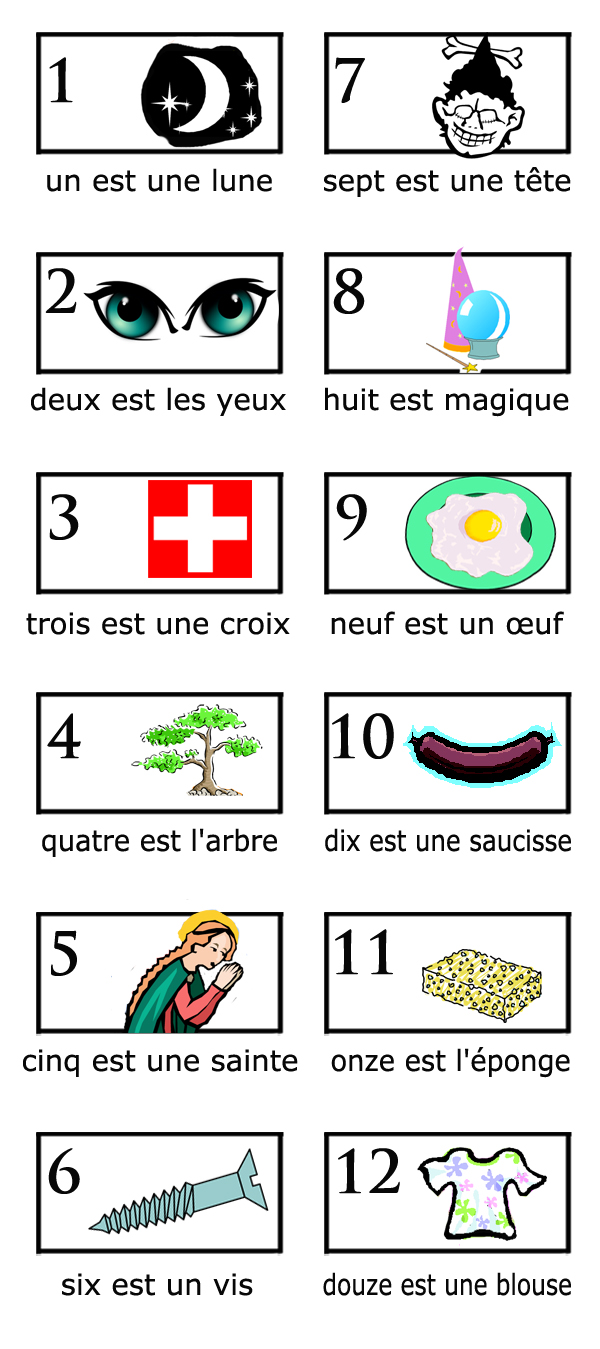
As with the original example, let's try it out with our cranial nerves.
En francais, les nerfs crâniens son:
Find out about the pegword mnemonic
Here are pegwords I've thought up in the French language.
As with the original example, let's try it out with our cranial nerves.
En francais, les nerfs crâniens son:
There have been quite a few studies looking into the possible benefits of omega-3 fatty acids and fish (a good source of the oils), particularly for older adults. Several large studies have found that regular intake of oily fish is associated with lower rates of dementia, and some evidence that eating fish regularly slows the rate of 'normal' age-related cognitive decline.
A general distinction you can make is that between:
Direct study is more important when you're learning a non-cognate language. It's also more important in the initial stages of learning a language. Learning from context is particularly useful for cognate languages.
Of course learning a language requires both approaches, but the relative proportions will vary.
It does appear that most component processes of cognition decline with advanced age if the difficulty level is sufficiently high. For example, the following processes have all shown age effects:
Coding mnemonics are used for encoding numbers. Because words are much easier for most of us to remember, a system that transforms numbers into letters is one of the best ways for remembering numbers — as seen in the modern innovation of encoding phone numbers into letters (0800-ANSETT).
A coding system is very useful for remembering numbers, but it must be said that few people have sufficient need to memorize long numbers to make the initial cost of learning the code acceptable.
In a recent news report, I talked about how walking through doorways creates event boundaries, requiring us to update our awareness of current events and making information about the previous location less available. I commented that we should be aware of the consequences of event boundaries for our memory, and how these contextual factors are important elements of our filing system. I want to talk a bit more about that.
Planning memory contains your plans and goals (such as, “I must pick up the dry-cleaning today”; “I intend to finish this project within three months”). Forgetting an appointment or a promise is one of the memory problems people get most upset about.
Learning a new language is made considerably more difficult if that language is written in an unfamiliar script. For some, indeed, that proves too massive a hurdle, and they give up the attempt.
Here’s an interesting study that’s just been reported: 72 seven- and eight-month-old infants watched video animations of familiar fun items being revealed from behind a set of colorful boxes (see the 3-minute YouTube video).
Have you ever been driving a car and suddenly you’re not sure what to do? You’re traveling along in usual automatic fashion and there comes a moment when you need to engage a new subroutine — say, you need to give way at an intersection, or you stall at the traffic lights, or you stop the car — and suddenly, you don’t know what to do. There’s a flash of panic, even while you’re thinking, “This is stupid, I’ve done this a thousand times”, and then, maybe it’s all right, maybe you have to take a moment to get your head in the right space, and ...