There are many memory strategies that can be effective in improving your recall of text. However, recent research shows that it is simplistic to think that you can improve your remembering by applying any of these strategies to any text. Different strategies are effective with different types of text.
Articles
Let's look a little deeper into the value of mnemonics for knowledge acquisition. By “knowledge acquisition”, I mean the sort of information you learn from textbooks — information that is not personal, that you need for the long-term.
In this context, I believe the chief value of mnemonic strategies is to help you recall information that needs to be remembered in a particular order. Thus we use mnemonics to help us remember the order of the planets, the order of musical notes on the stave, the order of the colors in a rainbow.
I recently reported on a finding that older adults whose life-space narrowed to their immediate home were significantly more likely to have a faster rate of global cognitive decline or develop mild cognitive impairment or Alzheimer’s.
I recently reported on a study showing how the gestures people made in describing how they solved a problem (the Tower of Hanoi) changed the way they remembered the game. These findings add to other research demonstrating that gestures make thought concrete and can help us understand and remember abstract concepts better.
Find out about the pegword mnemonic
Here are pegwords I've thought up in the Spanish language.
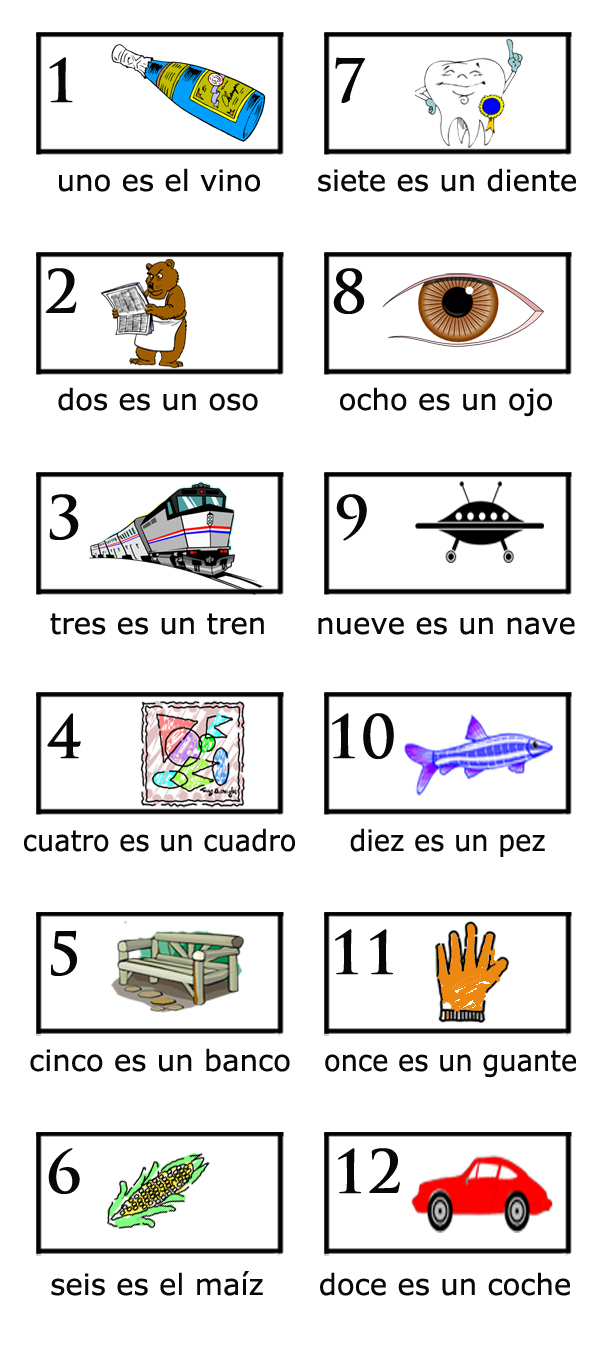
As with the original example, let's try it out with our cranial nerves.
En español, los nervios craneales son:
Reading is a deceptive skill, for it is not a single process, but a number of processes. Thus, while you might be a fluent reader, in that you can swiftly and easily decode the letter-markings, and quickly access the meaning of the words, that doesn't mean you're a skilled reader of informational texts.
To choose a strategy, you must assess the situation. In this case, this may mean an evaluation of a written text. Let's look at how you might evaluate text.
We can classify text at one of three different levels, according to its structure and density1:
Except in the cases of stroke or traumatic brain injury, loss of cognitive function is not something that happens all at once. Cognitive impairment that comes with age may be thought of as belonging on a continuum, with one end being no cognitive impairment and the other end being dementia, of which Alzheimer's is the most common type.
Many people, particularly as they get older, have concerns about short-term memory problems: going to another room to do something and then forgetting why you’re there; deciding to do something, becoming distracted by another task, and then forgetting the original intention; uncertainty about whether you have just performed a routine task; forgetting things you’ve said or done seconds after having said or done them; thinking of something you want to say during a conversation, then forgetting what it was by the time it’s your turn to speak, and so on.
I have previously reported on how gait and balance problems have been associated with white matter lesions, and walking speed and grip strength have been associated with dementia and stroke risk.