I recently read an interesting article in the Smithsonian about procrastination and why it’s good for you. Frank Partnoy, author of a new book on the subject, pointed out that procrastination only began to be regarded as a bad thing by the Puritans — earlier (among the Greeks and Romans, for example), it was regarded more as a sign of wisdom.
Articles
Why do we need sleep?
A lot of theories have been thrown up over the years as to what we need sleep for (to keep us wandering out of our caves and being eaten by sabertooth tigers, is one of the more entertaining possibilities), but noone has yet been able to point to a specific function of the sleep state that would explain why we have it and why we need so much of it.
Flashcards are cards with a word (or phrase) on one side and its translation on the other. You can buy ready-made flashcards, and these can certainly be helpful, particularly if you're inexperienced at learning another language. However, it is more effective if you make them yourself. Not only will the cards be customized to your own use, but the activity of selecting words and writing them down help you learn them.
Context is absolutely critical to successful communication. Think of the common experience of being a stranger at a family gathering or a meeting of close friends. Even familiar words and phrases may take on a different or additional meaning, among people who have a shared history. Many jokes and comments will be completely unintelligible, though you all speak the same language.
We all like simple solutions. However much we may believe we are ‘above’ black-&-white dichotomies, that of course we understand that every situation is complex, nevertheless we have a brain that can only think of a very very few things at once. So it's unsurprising that we are drawn to solutions that can be summed up simply, that can fit comfortably within the limitations of working memory.
Find out about the pegword mnemonic
Here are pegwords I've thought up in the Spanish language.
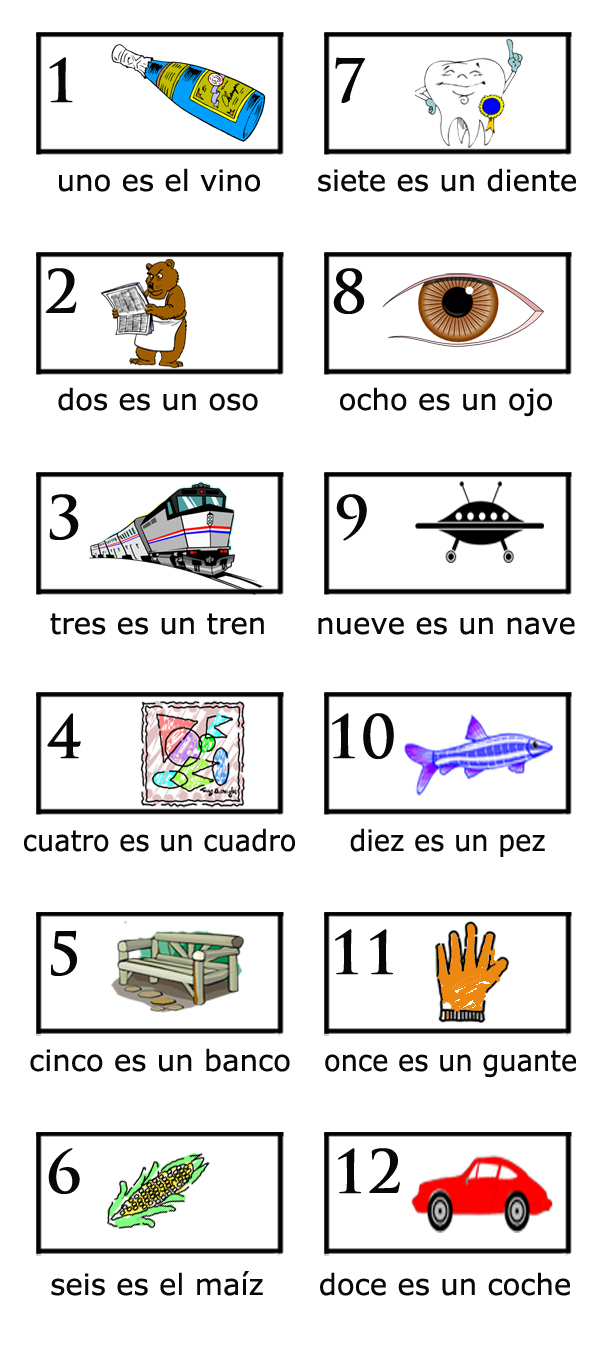
As with the original example, let's try it out with our cranial nerves.
En español, los nervios craneales son:
We don’t deliberately practice our memories of events — not as a rule, anyway. But we don’t need to — because just living our life is sufficient to bring about the practice. We remember happy, or unpleasant, events to ourselves, and we recount our memories to other people. Some will become familiar stories that we re-tell again and again. But facts, the sort of information we learn in formal settings such as school and university, these are not something we tend to repeatedly recount to ourselves or others — not for pleasure anyway!
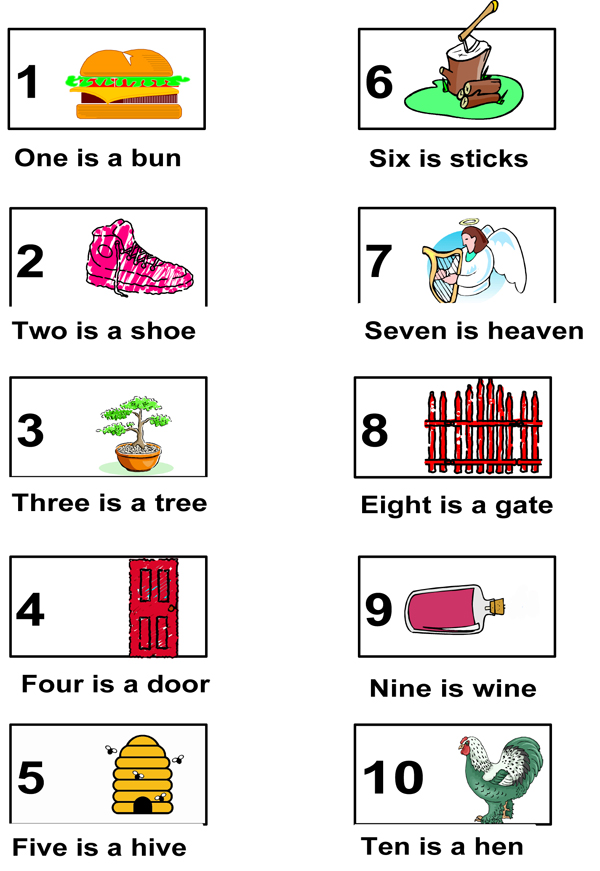
If you have a numbered list to memorize, the best mnemonic strategy is the pegword mnemonic. This mnemonic uses numbers which have been transformed into visual images. Here's the standard 1-10 set.
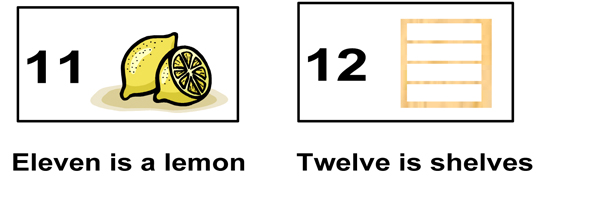
I add two more:
Many people, particularly as they get older, have concerns about short-term memory problems: going to another room to do something and then forgetting why you’re there; deciding to do something, becoming distracted by another task, and then forgetting the original intention; uncertainty about whether you have just performed a routine task; forgetting things you’ve said or done seconds after having said or done them; thinking of something you want to say during a conversation, then forgetting what it was by the time it’s your turn to speak, and so on.