This is the last part in my series on understanding scientific text. In this part, as promised, I am going to talk about the difficulties novices have with scientific texts; what they or their teachers can do about it; and the problems with introductory textbooks.
Articles
This post is the fourth and last part in a four-part series on how education delivery is changing, and the set of literacies required in today’s world. Part 1 looked at textbooks; Part 2 at direct instruction/lecturing; Part 3 at computer learning.. This post looks at learning models and types of literacy.
Literacy. What does it mean?
Have you ever been driving a car and suddenly you’re not sure what to do? You’re traveling along in usual automatic fashion and there comes a moment when you need to engage a new subroutine — say, you need to give way at an intersection, or you stall at the traffic lights, or you stop the car — and suddenly, you don’t know what to do. There’s a flash of panic, even while you’re thinking, “This is stupid, I’ve done this a thousand times”, and then, maybe it’s all right, maybe you have to take a moment to get your head in the right space, and ...
In the following case study, I explore in depth the issue of learning the geological time scale — names, dates, and defining events. The emphasis is on developing mnemonics, of course, but an important part of the discussion concerns when and when not to use mnemonics, and how to decide.
The Geological Time Scale
Phanerozoic Eon 542 mya—present
Cenozoic Era 65 mya—present
Find out about the pegword mnemonic
Here are pegwords I've thought up in the Italian language.
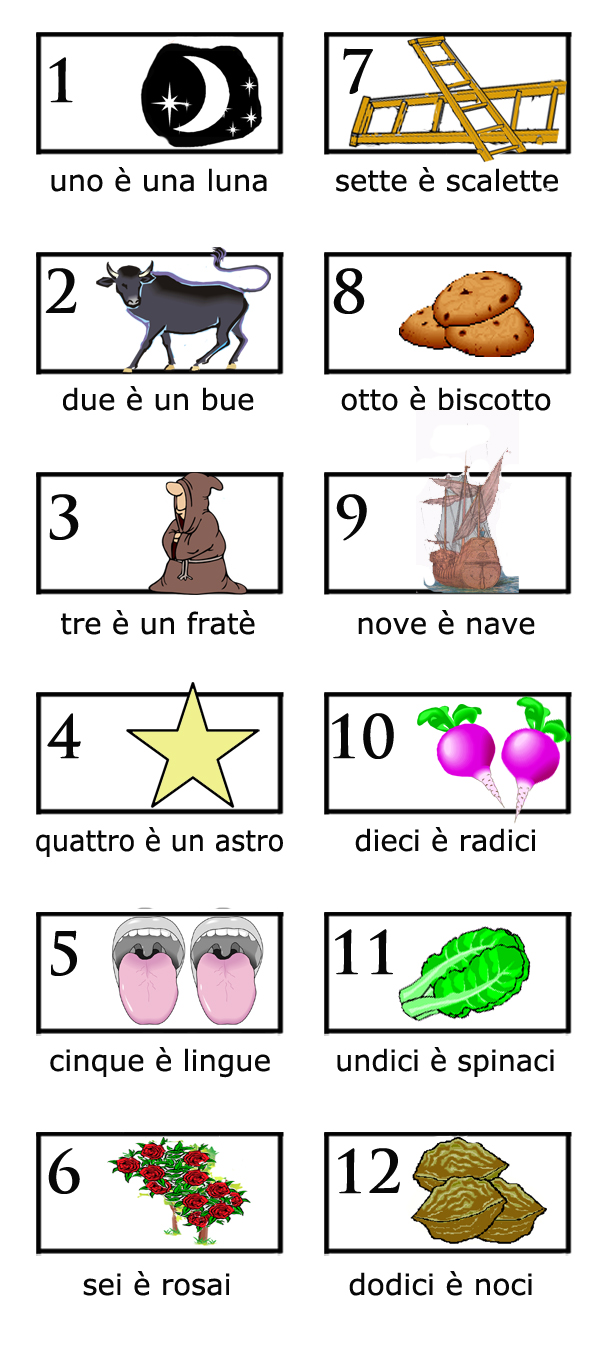
As with the original example, let's try it out with our cranial nerves.
In italiano, sono i nervi cranici:
You may have heard of “g”. It’s the closest we’ve come to that elusive attribute known as “intelligence”, but it is in fact a psychometric construct, that is, we surmise its presence from the way in which scores on various cognitive tests positively correlate.
In other words, we don’t really know what it is (hence the fact it is called “g”, rather than something more intelligible), and in fact, it is wrong to think of it as a thing. What it is, is a manifestation of some property or properties of the brain — and we don’t know what these are.
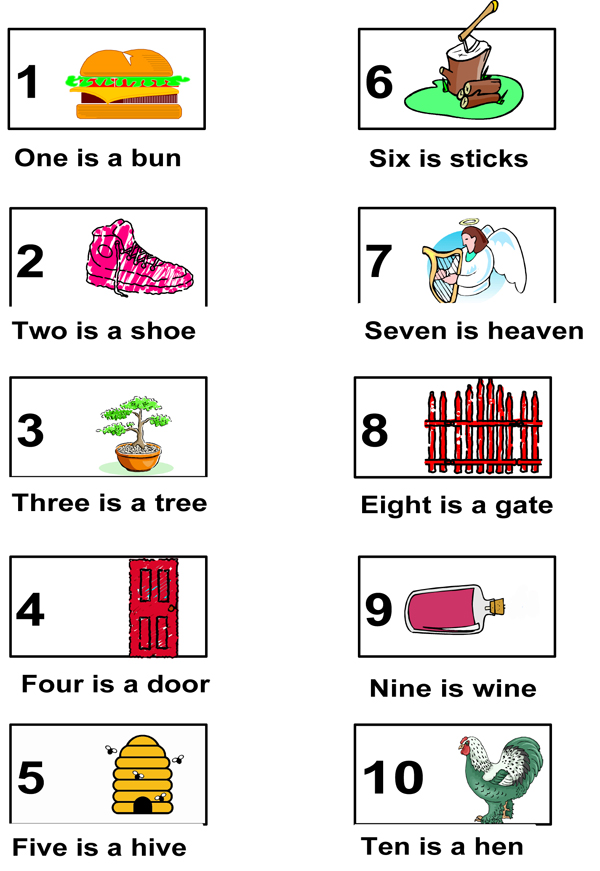
If you have a numbered list to memorize, the best mnemonic strategy is the pegword mnemonic. This mnemonic uses numbers which have been transformed into visual images. Here's the standard 1-10 set.
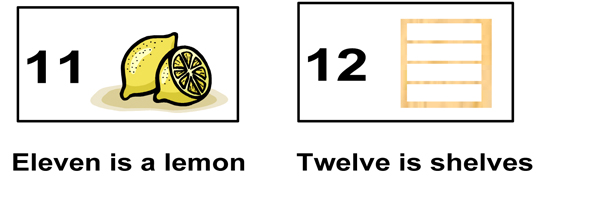
I add two more:
The Suggested Benefits of Homework
The most obvious presumed benefit of homework is, of course, that it will improve students' understanding and retention of the material covered. However, partly because this (most measurable) benefit has not been consistently demonstrated, it has also been assumed that homework has less direct benefits:
In the mid-seventies, Raugh and Atkinson had remarkable results using the keyword method to teach Russian vocabulary to college students. While later studies have not tended to find such dramatic results, nevertheless, a large number of studies have demonstrated an advantage in using the keyword mnemonic to learn vocabulary.
Some researchers have become huge fans of the strategy. Others have suggested a number of limitations. Let’s look at these.
To use note-taking effectively, you need to understand that its primary value is not in the record you produce, it is in the process itself. The process of taking notes guides the memory codes you make. Note-taking is a strategy for making information meaningful. It is therefore only effective to the extent that you paraphrase, organize and make sense of the information while taking notes.