
Articles

Intelligence in a cultural context

One theory of intelligence sees intelligence in terms of adaptiveness. Thus: "What constitutes intelligence depends upon what the situation demands" (Tuddenham 1963). Intelligence in these terms cannot be understood outside of its cultural context. Naturally to us it may seem self-evident that intelligence has to do with analytical and reasoning abilities, but we are perceiving with the sight our culture taught us.
Speed-reading techniques

Like many memory improvement courses, speed-reading programs tend to make inflated claims. Also like memory programs, most speed-reading programs proffer the same advice. In essence, speed-reading techniques involve the following components:

Distributed practice more effective than massed practice

It has long been known that spacing practice (reviewing learning or practicing a skill at spaced intervals) is far more effective than massed practice (in one heavy session). An interesting example of this comes from a study that aimed to find the best way of teaching postmen to type (this was at the request of the British Post Office). The researchers put postmen on one of four schedules:

Brain tissue is divided into two types: gray matter and white matter. These names derive very simply from their appearance to the naked eye. Gray matter is made up of the cell bodies of nerve cells. White matter is made up of the long filaments that extend from the cell bodies - the "telephone wires" of the neuronal network, transmitting the electrical signals that carry the messages between neurons.

The volume of gray matter tissue - a measure you will see cited in various reports - is a measure of the density of brain cells in a particular region.

Frances Yates described the memory strategy valued by the ancient Greeks and Romans as the "Art of Memory" in her widely quoted and seminal book The Art of Memory. Today we know it as the method of loci. But the Art of Memory, as those of the ancient world and those of the medieval world practiced it, is far richer than is implied by that title.

Widely cited gender differences in cognition

It is clear that there are differences between the genders in terms of cognitive function; it is much less clear that there are differences in terms of cognitive abilities. Let me explain what I mean by that.

It's commonly understood that males have superior spatial ability, while females have superior verbal ability. Males are better at math; females at reading. There is some truth in these generalizations, but it's certainly not as simple as it is portrayed.

I’ve recently had a couple of thoughts about flow — that mental state when you lose all sense of time and whatever you’re doing (work, sport, art, whatever) seems to flow with almost magical ease. I’ve mentioned flow a couple of times more or less in passing, but today I want to have a deeper look, because learning (and perhaps especially that rewiring I was talking about in my last post) is most easily achieved if we can achieve "flow" (also known as being ‘in the zone’).

Let’s start with some background.

What is neurogenesis?

Neurogenesis — the creation of new brain cells — occurs of course at a great rate in the very young. For a long time, it was not thought to occur in adult brains — once you were grown, it was thought, all you could do was watch your brain cells die!

Adult neurogenesis (the creation of new brain cells in adult brains) was first discovered in 1965, but only recently has it been accepted as a general phenomenon that occurs in many species, including humans (1998).

Visual Language, a term introduced by Robert Horn, refers to "language based on tight integration of words and visual elements". The visual elements include shapes, as well as images (e.g., icons, clip art).

What does this have to do with memory? Well, partly of course, because the appropriate use of images usually makes information more memorable, but visual language has considerably more to offer than that. To appreciate what it is, Horn has examples at http://web.stanford.edu/~rhorn/

Find out about the pegword mnemonic

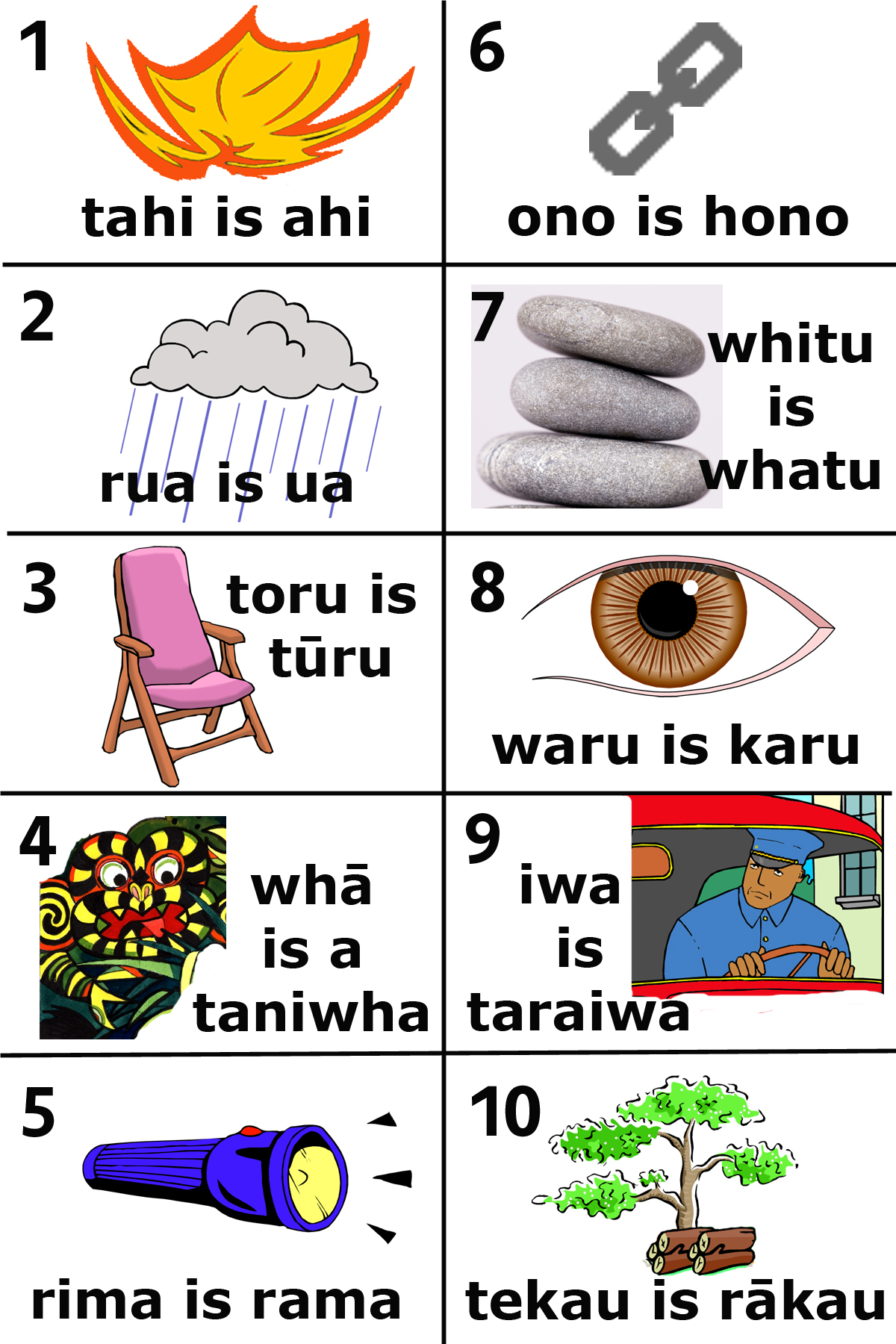
To celebrate Māori Language Week here in Aotearoa (New Zealand), I've put together a pegword set in te reo:

  1. tahi — ahi
  2. rua — ua
  3. toru — tūru
  4. whā — taniwha
  5. rima — rama
  6. ono — hono
  7. whitu — whatu
  8. waru — karu
  9. iwa — taraiwa
  10. tekau — rākau

Maori pegs